
Artists from different countries play an increasingly important role in the contemporary Irish art scene by contributing to exhibitions, participating in art education, and introducing new artistic approaches. In recent decades, Ireland has become a place where many international artists choose to study, live, and develop their work. As a result, contemporary Irish art reflects a variety of cultural perspectives and artistic traditions, which can be seen in the work of artists such as Atsushi Kaga and Vera Klute.
International artists bring different experiences and visual languages into the Irish context through their cultural backgrounds and artistic training. This can create new dialogues between cultures, as elements from different contexts are combined within their work and presented in Irish exhibitions and institutions.
Two key examples of international artists working in Ireland today are Atsushi Kaga and Vera Klute, whose work demonstrates how the relationship between origin and place can shape artistic practice. Both artists were born outside Ireland but later developed their professional careers within the Irish art context. Through their education, regular presentation of their work, and consistent artistic practice, they have become recognised figures in the contemporary Irish art scene. Their work demonstrates how artists from different countries can contribute to the development and diversity of art in Ireland by introducing new perspectives, particularly in their use of visual language and approaches to identity, while engaging with the local cultural environment.
Atsushi Kaga
Atsushi Kaga was born in Japan in 1978. He later moved to Ireland, where he studied painting at the National College of Art and Design in Dublin, completing both his BA and MFA. His education in Ireland played an important role in shaping his artistic practice by exposing him to contemporary painting approaches and allowing him to engage with the Irish art community through study and exhibitions.

Atsushi Kaga, artist portrait, date unknown. Painting in background: The last touch, 2022, acrylic and imitation gold leaf on canvas, 210 × 170 cm
Kaga is known for his expressive and imaginative paintings. His works often include fictional characters, animals, and narrative scenes constructed through simple forms and bold outlines. These characters sometimes appear playful or humorous, but they can also express more complex emotions, such as loneliness, anxiety, or confusion. Through these figures, Kaga explores themes such as identity, memory, and childhood by using storytelling and recurring characters that reflect personal and emotional experiences.

Atsushi Kaga, Moving forward like a snail, 2021, acrylic on canvas, 162 x 130 cm
His painting style is direct and expressive, often using strong colours and simplified forms. While the images may appear simple at first, they often suggest deeper psychological or symbolic meanings through the contrast between childlike imagery and more unsettling or ambiguous emotional content. This combination of humour, storytelling, and emotional depth has become a distinctive feature of his work.
Kaga’s paintings have been widely exhibited both in Ireland and internationally. In Ireland, his work has been shown in institutions such as the Irish Museum of Modern Art and the Royal Hibernian Academy. These exhibitions have helped to establish his work within major national art contexts, increasing its visibility among audiences and critics.
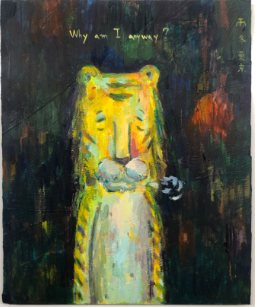
Atsushi Kaga, Why am I anyway. 2014-2017, acrylic on canvas, 22 × 18 × 0.5 cm
Although Atsushi Kaga was born in Japan, much of his artistic career has developed in Ireland. His work reflects a dialogue between different cultural experiences through the use of simplified forms, bold outlines, and recurring characters, as well as decorative elements such as gold backgrounds, as seen in works like The Last Touch (2022). These visual features combine playful, almost childlike imagery with a more complex emotional tone, which can be understood in relation to both his cultural background and his experience of living and working in Ireland.
Vera Klute
Vera Klute was born in Germany in 1981. She moved to Ireland to study at the National College of Art and Design in Dublin, where she completed her studies in fine art. After graduating, she continued to live and work in Ireland, gradually establishing herself as a professional artist through regular exhibitions and continued artistic practice.

Vera Klute, artist portrait
Klute is best known for her portrait paintings. Her work combines traditional painting techniques with contemporary ideas about identity, perception, and representation by using careful composition and subtle visual details that influence how the viewer interprets the subject. Many of her portraits depict single figures placed in quiet and sometimes unusual settings, such as empty landscapes or minimal interiors, often lacking clear spatial context, which isolate the figure and focus attention on their presence. The figures often appear calm and introspective, which creates a strong psychological atmosphere in the paintings through controlled facial expressions and restrained body language.

Vera Klute, Self-portrait, Oil on Canvas, 41 x 51cm
In addition to portraiture, Klute also explores themes of identity and transformation. Some of her works include elements that move beyond traditional portrait painting, such as unexpected settings or slightly altered proportions, creating surreal or symbolic images. These elements add another layer of meaning to her work by suggesting ambiguity and encouraging multiple interpretations, making her paintings visually intriguing.

Vera Klute, Fan, 2021, oil on linen, 93 x 123 cm
Her work has received important recognition in Ireland. In 2015, Klute won the Hennessy Portrait Prize at the National Gallery of Ireland. This prestigious award is given to outstanding contemporary portrait painters and is one of the most important portrait prizes in Ireland. The prize exhibition brought significant public attention to her work by presenting it to a large audience and positioning it within a major national institution, helping to strengthen her reputation within the Irish art community.
Klute has also exhibited regularly in galleries and institutions across Ireland. Through these exhibitions, she has built a strong presence in the Irish art world by consistently presenting her work in professional contexts and engaging with both audiences and curators, and she continues to develop her painting practice in Dublin.
The careers of Atsushi Kaga and Vera Klute illustrate how international artists can become an integral part of the contemporary Irish art scene through their education, professional development, and continued artistic practice in Ireland.
While both artists work in Ireland, their different backgrounds create distinct approaches to identity and representation. Kaga, for example, uses simplified forms, bold outlines, and recurring characters, often placed within decorative compositions, to create a narrative and emotionally ambiguous visual language. In contrast, Klute focuses on isolated figures placed in minimal or undefined spaces, using composition and atmosphere to emphasise psychological presence and introspection. This demonstrates how the experience of living and working in Ireland, combined with different cultural backgrounds, can lead to distinct and visually recognisable artistic approaches within contemporary Irish art.